The Arts and Crafts movement, both in America and internationally, was an era of the return to simplicity, fine craftsmanship, and anything handmade. It came out of the Victorian era, one of excess and extreme decoration, and changed design in a revolutionary way. Many designers and architects within this movement, also found themselves captivated by Japanese design and architecture, as well as anything Gothic.
The architecture of residential homes in this era was influenced by Philip Webb's idea that the exterior elements were just a result of the inward function of a building. The windows related to the activity of the rooms rather than the look of the facade. Interior design in this time period was heavily influenced and inspired by the ideas of William Morris and his firm, Morris and Company. Not only did the firm design simplistic furniture and houses, but they created beautiful wallpapers and other textiles that had "character and depth". Some of the popular designs were "Trellis", "Daisy", and "Fruit".
American architecture and interior design during this time was led by the firm "Green and Greene". Their popular home design acquired the name "Bungalow" and was popular in places like California.
The architecture of residential homes in this era was influenced by Philip Webb's idea that the exterior elements were just a result of the inward function of a building. The windows related to the activity of the rooms rather than the look of the facade. Interior design in this time period was heavily influenced and inspired by the ideas of William Morris and his firm, Morris and Company. Not only did the firm design simplistic furniture and houses, but they created beautiful wallpapers and other textiles that had "character and depth". Some of the popular designs were "Trellis", "Daisy", and "Fruit".
American architecture and interior design during this time was led by the firm "Green and Greene". Their popular home design acquired the name "Bungalow" and was popular in places like California.
 |
| "The Gamble House" by Greene and Greene https://artsandcraftshomes.com/travel/architecture-pasadena |
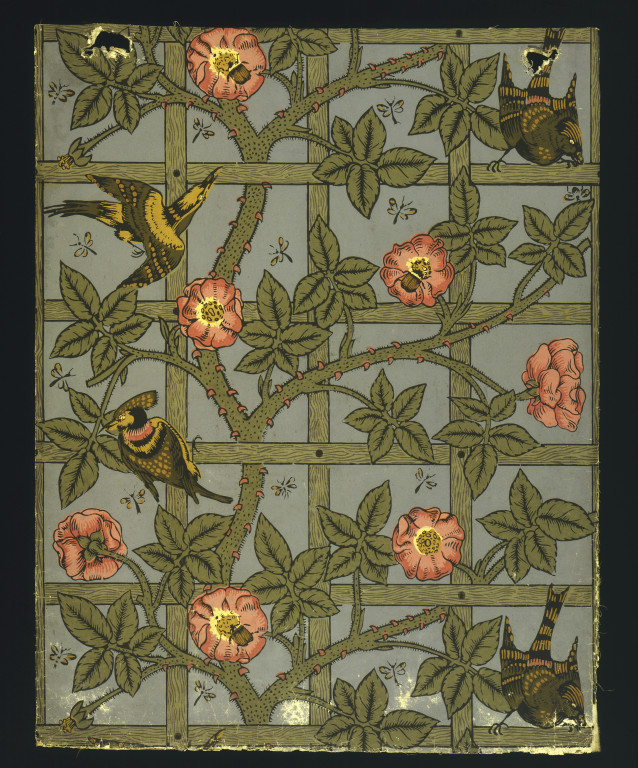 |
| "Trellis" by William Morris http://collections.vam.ac.uk/item/O78220/trellis-wallpaper-morris-william/ |
 |
| "Red House" by Philip Webb and William Morris http://newyorkfeed.org/arts-and-crafts-home-interiors/awesome-red-house-built-for-william-morris-google-search-arts-and-crafts-home-interiors/
The Arts and Crafts movement can still be seen today. Here are two current applications in home interiors:
 
One step further...
During my exploration of the Arts and Crafts movement, I was interested by William Morris. I was specifically intrigued with his idea that one should "have nothing in your house that you do not know to be useful, or believe to be beautiful". Interior design is often confused by people, to be the decorations in one's house. It can be thought to be clutter and messy. Although simple, Morris' idea is profound and beautiful. I found it interesting that he was somewhat of a jack of all trades. Aside from his textiles, furniture designs, and architecture designs, he was a writer. He must have known a thing or two about business as well, considering that his name is still selling things today. I even think that his idea of the adjustable armchair might be a precursor to today's recliner. William Morris showed what it meant for words and deeds to correlate with personal design and work ethic.
|


Olivia wonderful summary of the Arts and Crafts period. William Morris was wonderful and believe it or not people still use his wallcoverings today! Great Blog!
ReplyDeleteI find William Morris very interesting as well. His quote "have nothing in your house that you do not know to be useful, or believe to be beautiful" makes me think of the famous trend of today Minimalism. It seem like Minimalism and Arts and Crafts are similar in the way that one must be very thoughtful with what one puts in there house.
ReplyDeleteI feel like what the Arts and Crafts period brought up is still very useful in our daily lives today. It is easy to accumulate clutter, to go to stores and see pretty things that would look nice somewhere in the house but is not actually needed. I know I'm guilty of that sometimes myself but honestly there are so many things we find ourselves getting sometimes that we can do without. I also find William Morris interesting because as a designer, there's already a load of work to do but he excelled in other trades too and still made it as an excellent architect and designer.
ReplyDelete